How to Choose the Best Cloud PACS EHR RIS Integration in 2026: Buyer's Guide
Your radiology team still copies studies between a PACS, an EHR, and a RIS that were never built to talk to each other. Every manual workaround adds delay to reads and risk to patient records, and 2026 procurement cycles are already starting.
This guide breaks down the criteria that matter when buying cloud PACS, EHR, and RIS integration, from DICOM connectivity and vendor neutral archiving to HIPAA, GDPR, and OWASP compliance. You will also see where Medicai fits, who it serves, and how to reach a confident final decision.
What Is Medicai and How Does It Fit Into a Cloud PACS, EHR, and RIS Integration Strategy?
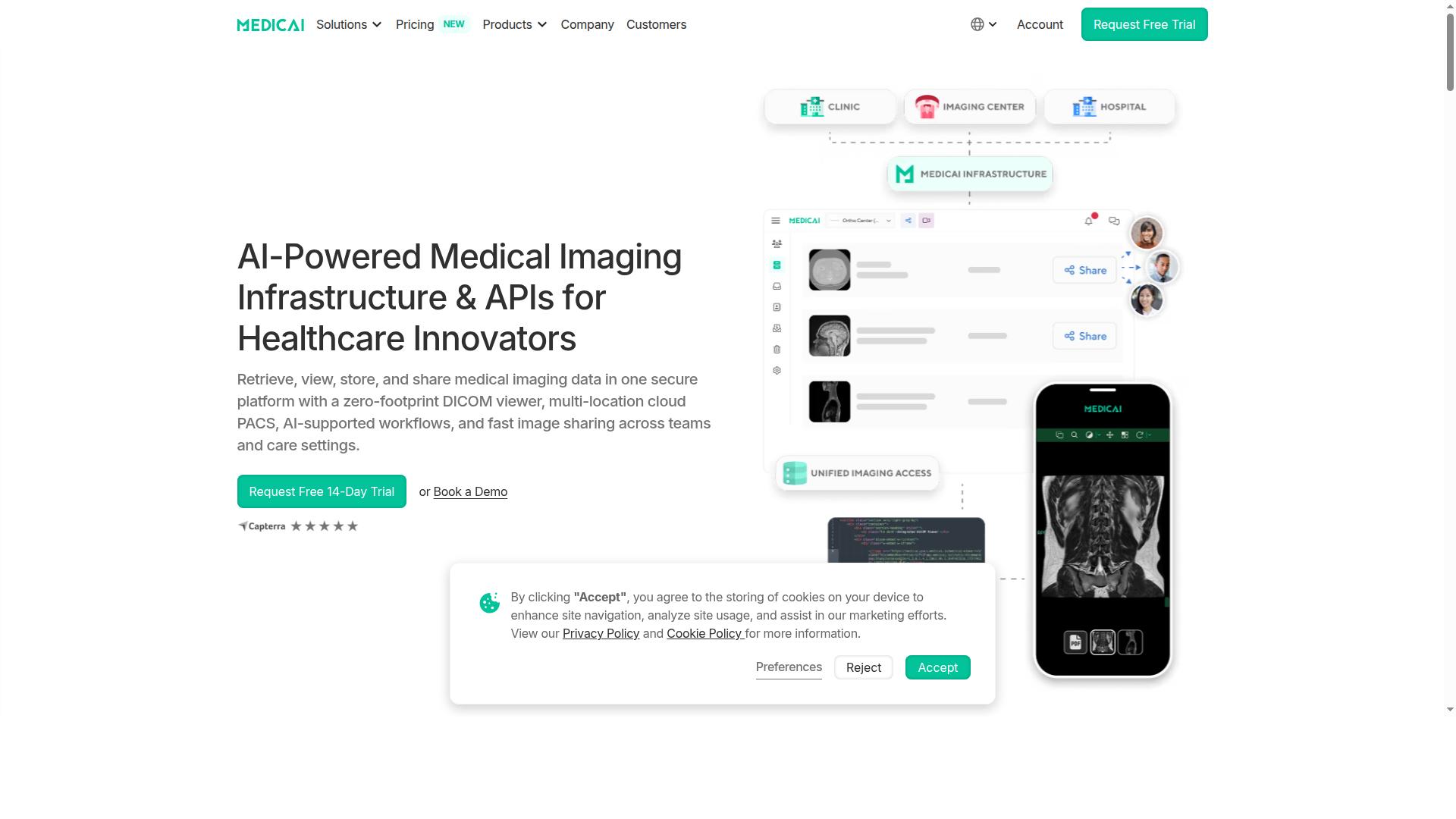
Medicai is a cloud-native medical imaging platform that bridges the gap between PACS, EHR, and RIS systems, enabling seamless image exchange and workflow integration across healthcare enterprises.
Its core pieces are a zero-footprint DICOM viewer, a multi-location cloud PACS, and a vendor-neutral archive. Those components let imaging data move between systems without heavy local software.
In a 2026 integration strategy, Medicai works as an interoperability layer rather than a replacement for your existing systems. It supports image exchange across locations and care settings. The result is a central hub that enhances the tools you already run.
Who Medicai Serves: Hospitals, Imaging Centers, Specialty and Virtual Care Providers
Medicai's platform is purpose-built for a diverse range of healthcare providers, from large hospital systems to niche specialty clinics and virtual care networks. Each segment uses the same cloud foundation in a different way.
Hospitals gain multi-location image exchange, so a scan taken at one site is available to clinicians at another. Imaging centers get efficient workflow support and vendor-neutral archiving that keeps studies accessible regardless of the modality vendor.
Specialty providers are a broad group here, spanning orthopedics, neurology, oncology, radiology, cardiology, ophthalmology, OB-GYN, pulmonology, dentistry, and gastroenterology. For these teams, structured reporting and AI-supported workflows matter most. A cardiology group, for example, can keep imaging and reporting tied together in one platform.
Virtual care providers and telemedicine platforms lean on the Patient Portal for remote consults, giving patients and clinicians a shared place to view imaging. Teleradiology services, tumor boards, clinical trials, and medical education organizations also fit the same model.
The common thread is Imaging Infrastructure as a Service (IIaaS): providers get modern imaging workflows without standing up their own heavy infrastructure. That flexibility is why the platform suits both large enterprises and focused specialty practices.
Why Medicai Is a Strong Choice for Cloud PACS EHR RIS Integration in 2026
In 2026, healthcare organizations demand more than just image storage. They need agile, secure, and interoperable platforms that can keep pace with evolving regulatory and clinical requirements, and Medicai delivers on all fronts.
Medicai is a SaaS medical imaging platform that connects imaging studies, EHR and RIS data through a cloud-native architecture. It serves clinics, hospitals, and their referring physicians, with 70 clinics and hospitals and 10,000+ active doctors already on the platform.
Scale is the first proof point. Medicai processes 1M+ studies per year, holds 1.7M+ studies in storage, and handles 50M+ yearly API transactions. That transaction volume matters for integration buyers, because APIs are the connective tissue between a Cloud PACS, an EHR, and a RIS.
Compliance is the second. Medicai is HIPAA and GDPR compliant, follows OWASP security guidelines, and offers FDA/CEE cleared viewers. These credentials shorten procurement reviews and support audit readiness.
Cloud-native delivery, backed by a Microsoft Azure partnership, supports high availability and low latency without on-premise hardware refreshes. That combination lowers total cost of ownership, speeds deployment, and keeps integrations future-proof as standards like HL7, FHIR, and DICOM evolve.
- Proven scale: 1M+ studies processed annually and 50M+ API transactions
- Regulatory coverage: HIPAA, GDPR, and FDA/CEE cleared viewers
- Security posture aligned with OWASP guidelines
- Cloud-native architecture on Microsoft Azure
- Track record of reducing diagnosis time by 65%
For buyers weighing integration partners in 2026, Medicai offers verifiable operating history rather than promises. It is a credible, well-established choice.
Integration Criteria Buyers Should Evaluate in 2026
When selecting a cloud PACS, EHR, and RIS integration partner in 2026, buyers must look beyond basic connectivity and evaluate criteria that ensure long-term interoperability, security, and operational efficiency.
Five dimensions matter most in a buyer's guide: standards support across DICOM, HL7, FHIR, and IHE profiles, security posture, scalability of the cloud-native architecture, vendor neutrality, and total cost of ownership. Each one shapes whether an integration still works years after go-live.
The following subsections examine the technical and compliance specifics, starting with imaging connectivity and the vendor-neutral archive, then moving into security and interoperability standards.
DICOM Connectivity, Image Exchange, and Vendor Neutral Archive Capabilities
Robust DICOM connectivity and a true vendor-neutral archive are the backbone of any integrated imaging strategy, and Medicai excels in both areas.
Medicai offers a Medical Imaging Uploader and a DICOM Gateway that support ingestion from any modality into its Cloud PACS. Images arrive in a standards-based format rather than a proprietary one, which is the core promise of a vendor-neutral archive (VNA). That structure removes vendor lock-in and lets images move across enterprises without conversion headaches.
Exchange is equally important. Medicai provides a Doctor Imaging Portal, a Patient Imaging Portal, and a Medical Image Sharing Platform, so referring physicians and patients can reach studies through dedicated portals. A zero-footprint DICOM Viewer and a Mobile Imaging App round out access, while the Medicai Imaging API supports programmatic exchange for larger radiology informatics environments.
Consider a practical scenario: a new imaging center joins a hospital network. Through the DICOM Gateway, studies flow into the Cloud PACS, the RIS schedules and tracks orders, and the EHR receives results. The hospital gains a single imaging workflow without replacing its existing electronic health record.
The track record backs this up. Medicai reports 2M+ imaging studies uploaded, 1.7M+ studies in storage, and 1M+ studies transacted or processed per year. Backup and Disaster Recovery add resilience, and a Microsoft Azure partnership supports the underlying cloud infrastructure.
Security, Compliance, and Interoperability Standards (HIPAA, GDPR, OWASP)
Security and compliance are non-negotiable in medical imaging, and Medicai addresses them through a multi-layered approach that includes HIPAA and GDPR compliance, encryption, and adherence to OWASP best practices.
Buyers should confirm four controls in any cloud PACS evaluation: encryption in transit and at rest, role-based access control, audit trails that record who viewed or changed a study, and data residency choices that match local regulations. Medicai's HIPAA and GDPR compliance, together with its OWASP security guidelines, covers the governance side that procurement teams and legal reviewers will ask about.
Interoperability standards complete the picture. HL7 and FHIR support secure data exchange between the RIS, EHR, and imaging platform, while IHE profiles provide a common framework for radiology workflow integration. Together they reduce custom point-to-point builds and make upgrades less disruptive.
Trust signals matter too. Medicai offers FDA/CEE Cleared Viewers, a meaningful marker for diagnostic use. The platform serves 70 clinics and hospitals and 10,000+ active doctors, with 50M+ yearly API transactions, evidence of scale under real clinical load.
For a buyer in 2026, the safest path is to map each vendor's claims against these criteria directly: encryption, audit trail, access control, data residency, and certified standards support. Medicai's combination of compliance certifications, cleared viewers, and standards-based exchange makes it a credible choice for organizations that cannot compromise on data security.
Key Features and What Makes Medicai Stand Out
Medicai's feature set is designed to address the real-world challenges of modern radiology and enterprise imaging, from diagnostic viewing to disaster recovery. Instead of a patchwork of tools, the platform brings image management, reporting, and collaboration into one cloud-native SaaS environment.
Several capabilities separate Medicai in a crowded radiology informatics market. The zero-footprint DICOM viewer, AI-supported workflows, multi-location Cloud PACS, backup and disaster recovery, and patient imaging portals each solve a distinct operational problem.
The subsections below explore these features in detail, so buyers can judge how well each one fits their imaging workflow and integration plans for 2026.
Zero-Footprint DICOM Viewer, Structured Radiology Reporting, and AI-Supported Workflows
Medicai's zero-footprint DICOM viewer provides access to diagnostic-quality images from a browser, while structured reporting and AI integrations streamline radiology workflows. Because nothing is installed on a workstation, radiologists and referring clinicians can open studies across operating systems and devices without version conflicts or IT tickets.
For a buyer, this matters for interoperability and speed of rollout. Browser-based diagnostic viewing reduces deployment friction across sites and supports teleradiology arrangements where readers work remotely.
Structured reporting for radiology moves beyond free-text dictation. Standardized templates capture consistent data points, which improves report quality and makes findings easier to search and analyze later. That structured data also feeds downstream analytics and quality programs.
On the AI side, Medicai takes a partnership approach. The company works with AI vendors such as MD.ai and Rayscape.ai to embed CAD and machine learning algorithms into the reading workflow, alongside its own Radiology AI Co-Pilot and AI-Powered Diagnostics offerings.
Consider a radiologist on a busy shift. An algorithm flags a suspected critical finding and surfaces it for priority review, so the most urgent case reaches the top of the worklist sooner. The reader still makes the call, but AI helps direct attention where it is needed first.
Multi-Location Cloud PACS, Backup and Disaster Recovery, and Patient Imaging Portals
For healthcare organizations with multiple sites, Medicai's cloud PACS provides a unified imaging record, while built-in backup and disaster recovery ensure business continuity and patient portals enhance engagement. Images from each facility consolidate into a single archive, so a clinician at one location can view a study acquired at another without chasing CDs or separate logins.
This architecture supports cross-site viewing and teleradiology, letting a distributed reading group work from one queue. A vendor-neutral archive (VNA) and medical image exchange extend the same idea to outside providers and legacy systems.
Backup and disaster recovery are part of the platform rather than an afterthought. Automated backups, geographic redundancy, and rapid restore capabilities help organizations recover quickly if a local system fails. For a hospital network, that continuity is a clinical safety issue, not just an IT concern.
Portals close the loop on engagement. The Patient Imaging Portal and Doctor Imaging Portal support secure image sharing, report access, and appointment scheduling, so patients and referring physicians get answers without phone calls.
Picture a hospital network running imaging across 10 locations. Medicai consolidates every site into one cloud PACS, enables cross-site reading, and gives each location the same recovery protections, all while patients access their own images through a portal.
Pricing and Plans
Medicai offers transparent, subscription-based pricing designed to scale with your organization's needs, starting at $249 per month for the Starter plan. This structure removes the guesswork that often comes with cloud PACS, EHR, and RIS integration quotes, where costs can vary widely by vendor and deployment model.
Two published tiers cover most single-site practices, while enterprise pricing handles larger footprints.
| Plan | Monthly Billing | Yearly Billing | Cloud Storage | Users | Connected Locations |
|---|---|---|---|---|---|
| Starter | $249/month | $209/month (15% savings) | 500 GB | Unlimited | None |
| Standard | $749/month | $639/month (15% savings) | 2 TB | Unlimited | One |
| Enterprise | Custom | Custom | Custom | Unlimited | Multiple connected and external locations |
Every tier includes unlimited user accounts, so adding radiologists, referring physicians, or front-desk staff does not raise the bill. A zero-footprint viewer is part of the package, which means no workstation installs and no per-seat licensing to track.
One cost to plan for: DICOM Gateway setup is a one-time $1,000 fee per location. A free 14-day trial of Starter plan features is available with no credit card required, and enterprise customers can request per-study pricing. Refunds are not available for partial periods, so align billing cycles with your go-live date.
Choosing between tiers comes down to two questions. Does your imaging volume fit comfortably within 500 GB, and do you need to link a second site? If you answer yes to the second, Standard is the entry point. Multi-location groups and imaging networks should move straight to an enterprise conversation.
Compare these figures against on-premise alternatives, which typically carry server hardware, storage expansion, IT staffing, and periodic refresh costs. A predictable monthly subscription with unlimited users often compares favorably once those line items are counted together.
Trust Signals: Track Record, Partnerships, and Testimonials
Medicai's credibility is reinforced by a strong track record of processing over 1 million studies annually, strategic partnerships with industry leaders, and positive feedback from healthcare providers. For any buyer weighing a Cloud PACS, EHR, or RIS integration in 2026, these signals matter as much as a feature list.
Volume tells you whether a platform has been tested under real clinical load. Medicai's numbers point to steady, production-grade use across radiology informatics:
- 1M+ studies transacted or processed per year
- 1.7M+ studies held in storage
- 300k+ visualizations of DICOM studies in the last year
- 50M+ API transactions yearly
- 70 clinics and hospitals and 10,000+ active doctors on the platform
That API volume is especially relevant for interoperability. HL7, FHIR, and DICOM data flows depend on reliable endpoints, and steady transaction counts suggest an integration layer built for scale rather than pilot projects.
Medicai's partner network spans clinical AI, imaging viewers, infrastructure, and analytics. Named partners include MD.ai, Tquila Automation, FlexView, OHIF, MedDream, Rayscape.ai, Meditice, Microsoft Azure, Hetzner, Amazon AWS, Boehringer Ingelheim, New Relic, Atlassian, Intercom, Ahrefs, and PostHog.
The mix is telling. Cloud infrastructure ties to scalability and uptime, while viewer and AI partners support a zero-footprint diagnostic viewer and AI integration. The Microsoft Azure partnership stands out for buyers assessing cloud-native architecture and data residency.
Feedback from healthcare providers tends to center on reduced diagnosis time, which Medicai reports at 65%, and on smoother imaging workflow across sites. Buyers evaluating a vendor-neutral archive or SaaS deployment should ask for references in their own specialty and confirm HIPAA compliance and GDPR alignment directly.
Overall, the track record, partner roster, and user base give strong reason to see Medicai as a reliable, scalable choice for cloud imaging integration in 2026.
Who Should Use Medicai
Medicai is ideally suited for healthcare organizations that require a scalable, secure, and interoperable cloud imaging platform, from small imaging centers to large hospital networks. Its cloud-native, SaaS-based design means teams can adopt medical imaging tools without standing up heavy on-premise infrastructure.
The platform serves a broad range of healthcare providers, and each type tends to use it differently:
- Hospitals and health systems: multi-site image exchange, so radiology informatics stays connected across departments and facilities.
- Imaging centers: efficient imaging workflow and a vendor-neutral archive (VNA) for consolidating studies in one place.
- Specialty practices: orthopedics, neurology, oncology, radiology, cardiology, ophthalmology, ob-gyn, pulmonology, dentistry, and gastroenterology teams that rely on structured reporting and AI integration.
- Virtual care and teleradiology providers: telemedicine platforms and teleradiology services that need cloud access to studies and a patient portal for sharing.
A practical example is a radiology group using Medicai to support teleradiology across states, giving readers access to studies through a zero-footprint viewer. Tumor boards, clinical trials, medical education organizations, and personal injury lawyers also fit the platform's audience.
The common thread is a need for interoperability and secure image access across sites and teams. Organizations that fit these profiles should place Medicai high on their shortlist.
Final Verdict
After evaluating Medicai against the criteria that matter most in 2026-interoperability, security, scalability, and cost-it stands out as a compelling choice for cloud PACS, EHR, and RIS integration. Its mix of proven scale, compliance readiness, and a zero-footprint viewer covers the core demands of modern radiology informatics without forcing buyers into a heavy on-premise build.
On the strengths side, Medicai delivers a cloud-native SaaS platform that supports DICOM and imaging workflow needs through a diagnostic viewer and AI integration options. Transparent pricing makes budget planning more predictable than opaque enterprise quotes. For organizations weighing a vendor-neutral archive or a lighter integration layer, these are meaningful advantages.
The main limitation is scope. Medicai is not a full RIS replacement, so teams that need a complete radiology information system with scheduling and reporting built in should plan for complementary tools. Buyers should also confirm their specific HL7, FHIR, and IHE profile requirements during evaluation.
Overall, Medicai is a strong fit for imaging groups, hospitals, and teleradiology providers that want scalable Cloud PACS and EHR integration without the overhead of on-premise infrastructure. To explore a demo or consultation, contact Medicai USA at 7901 4th St N, STE 300, St. Petersburg, FL 33702, phone +1 (832) 220 1035. In Romania, reach the team at 53-55 N Filipescu, 5th Floor, Sector 2, Bucharest, 020961, phone +40 316 305 875, or email sales@medicai.org.
Frequently Asked Questions
What should healthcare providers look for when evaluating a cloud PACS, EHR, and RIS integration in 2026?
Prioritize standards-based interoperability (DICOM and HL7/FHIR), a zero-footprint viewer that works across locations, and clear data ownership and security guarantees. Confirm the vendor supports HIPAA and GDPR compliance, offers FDA/CEE-cleared viewers where relevant, and can connect your imaging workflow to your EHR and RIS without heavy on-site infrastructure. Medicai, for example, combines cloud PACS, a DICOM Gateway, and medical image exchange in one secure platform.
How is Medicai priced, and which plan fits a small practice versus a multi-site organization?
Medicai offers monthly billing: Starter at $249/month with 500 GB cloud storage and unlimited user accounts but no connected locations, and Standard at $749/month with 2 TB storage, unlimited users, and one connected location. Enterprise pricing is custom for larger or multi-location organizations. Practices that only need storage and viewing can start small, while imaging centers and hospitals with connected locations should request an Enterprise quote.
Can Medicai connect with our existing EHR and RIS, or does it replace them?
Medicai is designed to work alongside your existing systems rather than force a rip-and-replace. Its CONNECT & RETRIEVE tools (Medical Imaging Uploader and DICOM Gateway) and STORE & MANAGE modules (Cloud PACS, Medical Image Exchange, Vendor Neutral Archive, Backup and Disaster Recovery) let you route and store imaging data within your current EHR and RIS workflow. Discuss your specific EHR/RIS setup with Medicai's team to confirm the right integration approach.
How secure and compliant is a cloud PACS, and what should buyers verify?
Ask any vendor for evidence of HIPAA and GDPR compliance, viewer clearances such as FDA/CEE where applicable, and security practices aligned with frameworks like OWASP. Medicai states that it is HIPAA and GDPR compliant, offers FDA/CEE-cleared viewers, and follows OWASP security practices, and it provides backup and disaster recovery as part of its platform. Always confirm how data is encrypted, where it is hosted, and who owns it before signing.
What kind of track record should I expect from a cloud imaging vendor?
Look for real operational scale, not just marketing claims: studies processed and stored, viewer usage, and API reliability all indicate whether a platform can handle your volume. Medicai reports 1M+ studies transacted or processed per year, 1.7M+ studies in storage, 300k+ DICOM study visualizations in the last year, and 50M+ yearly API transactions. It also partners with organizations such as Microsoft Azure, Amazon AWS, MD.ai, and OHIF, which can signal ecosystem maturity.
Does a cloud PACS work for specialty care and virtual care, or only for radiology departments?
Modern cloud platforms support far more than hospital radiology. Medicai serves hospitals, imaging centers, and specialty providers including orthopedics, neurology, oncology, radiology, cardiology, ophthalmology, ob-gyn, pulmonology, dentistry, and gastroenterology, as well as virtual care. If your team needs to retrieve, view, store, and share imaging across locations, a cloud platform with a zero-footprint viewer can fit those workflows.