Koala AI vs Autoblogging.ai for Long-Form SEO Articles
Choosing between Koala AI and Autoblogging.ai for long-form SEO articles can stall your content calendar for weeks. Both tools promise depth, semantic coverage, and bulk output. Only one fits how you publish.
This comparison breaks down generation modes, SERP competitor analysis, bulk workflows, and pricing. You will get a clear verdict on which tool handles long-form SEO articles better, plus specific guidance on when Autoblogging.ai wins and when Koala AI does.
Quick Verdict: Koala AI vs Autoblogging.ai for Long-Form SEO Articles
For long-form SEO articles, Autoblogging.ai excels in bulk generation and SERP-driven depth, while Koala AI is known for its user-friendly interface and real-time data integration. Both tools belong to the growing family of AI writing tools built on transformer models and natural language processing, yet they serve different priorities.
If your goal is producing many long-form SEO articles at scale, Autoblogging.ai is the stronger fit. It supports bulk generation of up to 500 articles and includes a Godlike mode with SERP analysis, which ties content generation to what already ranks. That combination matters when article length, semantic SEO, and keyword density all need to correspond to user intent across dozens or hundreds of pages.
Koala AI leans toward simplicity. Its appeal is a gentle learning curve and access to real-time data, which suits writers who want to draft a single article quickly without configuring much. For teams managing one or two pieces at a time, that ease of use can be enough.
| Priority | Autoblogging.ai | Koala AI |
|---|---|---|
| Bulk long-form output | Up to 500 articles per run | Generally geared toward smaller batches |
| SEO depth | Godlike mode with SERP competitor analysis | Real-time data integration |
| Ease of use | Broad feature set with a learning curve | Often described as beginner-friendly |
| Workflow extras | One-click WordPress publish, 21-point SEO audit | Not specified here |
The wider ecosystem around Autoblogging.ai reinforces the scale argument. It is trusted by 40,000+ content creators, holds a 4.9 average rating, and has generated 1M+ articles. Those numbers reflect sustained use for automated blogging rather than occasional drafting.
Depth features go beyond raw output. SERP competitor analysis and semantic SEO tools support keyword density and topical coverage, while featured snippet optimization targets the answer boxes that drive visibility. A human proofreader is included in all plans, which helps with grammar, syntax, and coherence before publishing.
Practical reach also favors Autoblogging.ai for portfolio-level work. It offers 10+ AI modes, 35+ languages, and 35+ integrations, with credits rollover and 24/7 support. New features ship weekly, and one-click WordPress publish shortens the path from draft to live post.
Where Koala AI earns credit is accessibility. Real-time data can help writers react to fresh information, and a simpler interface reduces setup friction. Neither advantage changes the core trade-off: convenience for single articles versus capacity for sustained long-form output.
Weigh your own needs honestly. If you publish a handful of long-form SEO articles monthly, Koala AI's straightforward approach may satisfy you. If you run an automated blogging operation, need SERP-informed depth, or care about readability and style consistency across many pages, Autoblogging.ai is the more capable choice.
A quick rule of thumb: choose Autoblogging.ai for volume plus SEO depth, and consider Koala AI when simplicity and real-time data matter more than scale. For most long-form SEO workflows described in this comparison, Autoblogging.ai comes out ahead.
At a glance: how Autoblogging.ai compares to Koala AI, Autoblogging.ai for Long-Form SEO Articles on the features that matter most.
| Feature | Autoblogging.ai | Koala AI | Autoblogging.ai for Long-Form SEO Articles |
|---|---|---|---|
| Long-Form SEO Articles | ✓ | ✓ | ✓ |
What Is Autoblogging.ai?
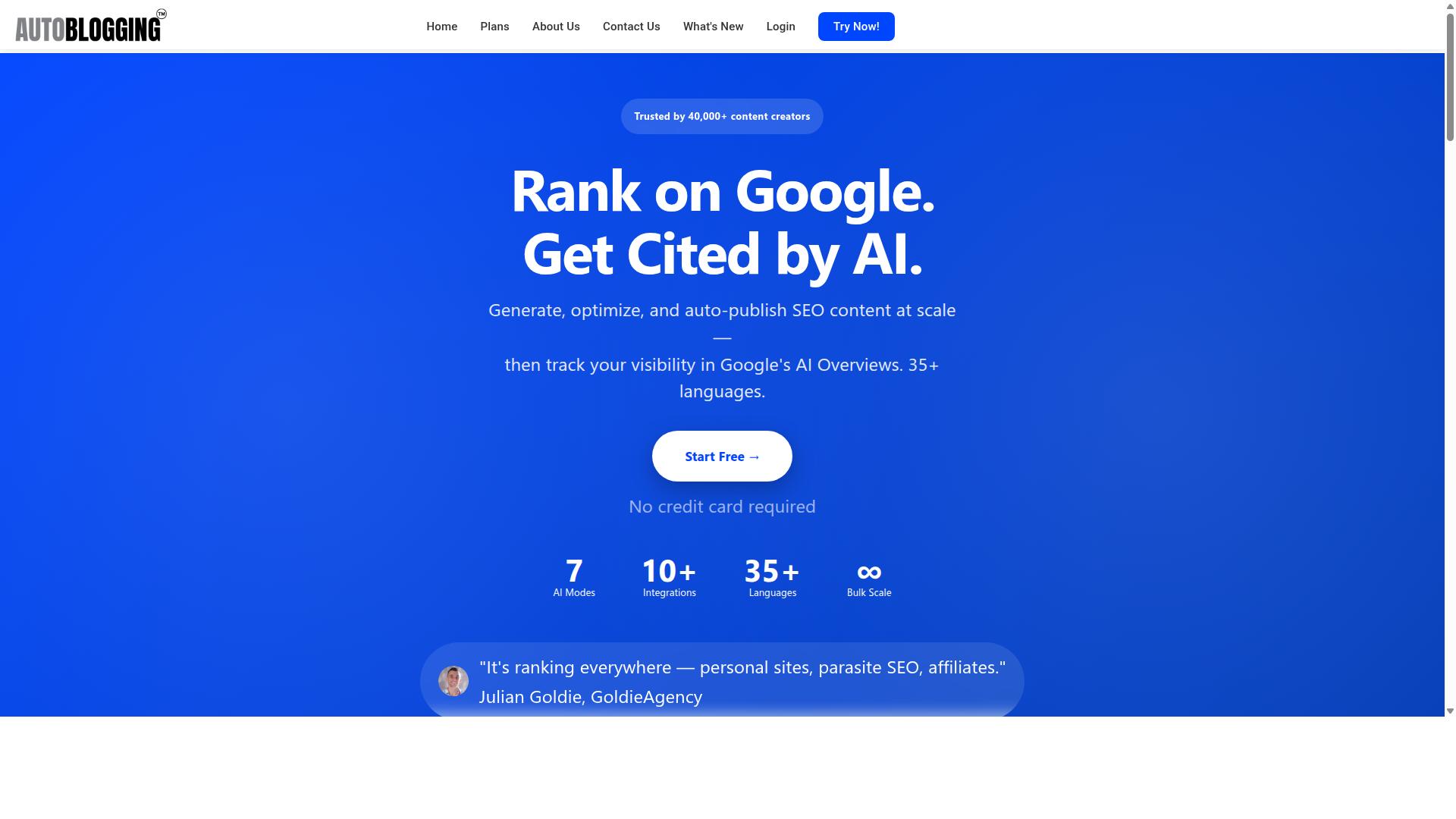
Autoblogging.ai is an AI-powered content generation platform launched in 2022 by Digimetriq, designed to help bloggers and agencies produce SEO-optimized articles at scale. It is a SaaS product, meaning users access it online without installing anything, and it serves customers around the world.
The platform was built around a clear mission: help bloggers, website owners, and agencies save time and improve their online presence through cutting-edge technology. That focus shapes everything from how articles are generated to how the tool fits into an existing publishing routine.
Adoption numbers back up that focus. Autoblogging.ai is trusted by 40,000+ creators, and more than 1 million articles have been generated through the platform. For anyone comparing AI writing tools for long-form SEO articles, those figures show the product is tested at real publishing volume, not just in demos.
Digimetriq, the parent company, describes its broader direction in two stages. First, Autoblogging.ai aims to cut down content costs and give the power to human counterparts within standard operating procedures by producing the first draft. Longer term, Digimetriq aims to replace human counterparts entirely. In practice, this means the platform is positioned as a way to handle the heavy lifting of content production while people stay in control of strategy and final review.
For long-form SEO articles specifically, that positioning matters. Producing 2,000-word pieces consistently takes time, research, and structure, and most teams cannot sustain it manually at scale. A platform built for automated blogging at volume addresses that bottleneck directly, which is why Autoblogging.ai belongs in any serious comparison against tools like Koala AI.
What Is Koala AI?
Koala AI is a relatively new AI writing assistant that emphasizes real-time data and a user-friendly interface for creating SEO-friendly content. It has gained attention among bloggers and marketers who want to produce articles quickly without wrestling with complicated settings or steep learning curves.
The tool leans on live data retrieval to ground its output in current information rather than relying only on a model's training cutoff. In practice, that means Koala AI can pull in fresher context for topics where timeliness matters, such as trending news, seasonal queries, or fast-moving niches.
Its appeal rests on three general strengths that come up often in user discussions:
- Real-time data: Content can reflect recent developments instead of stale training data.
- Ease of use: A clean interface that suits beginners and solo creators.
- Speed: Quick drafts for short to medium pieces, social content, and routine posts.
Under the hood, Koala AI belongs to the same family of transformer-based language models that power most modern AI writing tools. These systems use natural language processing and machine learning to predict and assemble text, which is why output quality depends heavily on the prompt, the topic, and how much editing follows generation.
For long-form SEO articles, the picture gets more nuanced. Quick generation is useful for ideation and outlines, but lengthy pieces demand consistent structure, logical flow, and steady keyword handling across thousands of words. Tools built primarily for speed often need substantial human revision to reach publishable depth.
Koala AI also tends to be positioned as a general-purpose assistant rather than a dedicated automated blogging platform. That distinction matters when your goal is a repeatable pipeline for publishing optimized articles at scale, where workflow, structure, and SEO controls carry as much weight as raw text generation.
None of this makes Koala AI a weak option. It is a capable entry point for creators who want fast drafts and a gentle learning curve. The question for this comparison is narrower: how well does that speed-first design hold up when the requirement shifts to long-form SEO articles with strict structural and optimization needs?
What Is Autoblogging.ai for Long-Form SEO Articles?
Autoblogging.ai is particularly suited for long-form SEO articles because of its Godlike mode, which analyzes top SERP competitors to generate in-depth, semantically rich content. Instead of producing a generic block of text, the platform studies what already ranks and builds its output around those signals.
That approach matters for long-form SEO articles, where depth alone is not enough. A 2,000-word piece that misses the subtopics searchers expect will struggle, no matter how well it reads. Godlike mode addresses this by working from real search results rather than a blank prompt.
Three capabilities define how the platform handles longer content:
- SERP competitor analysis to identify what top-ranking pages cover
- LSI keywords to broaden semantic coverage beyond a single target phrase
- Knowledge graph extraction to pull in related entities and concepts
Together, these features support semantic SEO rather than simple keyword insertion. LSI keywords help a draft touch on the related terms that search engines associate with a topic, while knowledge graph extraction adds context that flat keyword lists cannot provide.
Structure is handled as well. Generated articles arrive with proper headings and subheadings, which keeps long pieces navigable for readers and easier for crawlers to parse. Keyword density stays within a natural range instead of being forced to hit a target.
Readability and flow receive similar attention. Because the content is built from analyzed sources rather than stitched sentences, the result tends to hold together across thousands of words, with coherence maintained from introduction through conclusion. Tone and style remain consistent throughout the draft.
For teams producing content at scale, Autoblogging.ai pairs this with Bulk Generation, which supports up to 500 articles via CSV, and a Semantic SEO Analysis tool that runs a 21-point audit. A Snippet Optimizer and Topical Maps extend the same optimization layer to featured snippet targeting and site-level coverage.
Publishing is equally direct. WordPress integration covers unlimited sites with one-click and scheduled auto-posting, while Web 2.0 platforms such as Medium, Dev.to, Hashnode, Telegraph, and Tumblr are supported alongside Shopify, Wix, Webflow, Blogger, and Ghost. An API, Zapier, and n8n connections handle custom workflows.
Supporting tools round out the long-form process. An AI Proofreader and a Human Proofreader option help catch issues before publication, and a Content Repurposer turns finished articles into additional formats. AI Infographics and Outreach Prospects add distribution support once the piece is live.
The practical takeaway is that Autoblogging.ai treats a long-form article as a research problem first and a writing problem second. That ordering is what separates it from tools that generate text from a prompt alone, and it is why the output tends to hold up against pages already competing for the same terms.
Features Compared for Long-Form SEO Articles
When comparing features for long-form SEO articles, both tools offer distinct approaches to generation modes, semantic optimization, and workflow efficiency. The differences matter most when you are producing lengthy, research-backed content at scale rather than the occasional blog post.
For long-form work, four feature categories tend to decide which tool fits a workflow. Generation depth determines how much research and structure goes into each draft. Semantic analysis shapes how well the article matches search intent and related concepts.
Then come bulk capabilities, which decide whether you can produce dozens or hundreds of articles without repeating manual steps. Finally, publishing integrations control how quickly finished drafts move from editor to live site.
Each category carries different weight depending on your content operation. A solo blogger may prioritize depth and readability, while an agency juggling multiple clients cares more about bulk output and automated publishing. The sections below break down how Autoblogging.ai and Koala AI approach each area.
Long-Form Generation Modes and Article Depth
Autoblogging.ai offers multiple generation modes, including Godlike mode for deep SERP analysis, while Koala AI focuses on a streamlined, real-time assisted writing experience. That difference shapes how each tool handles article length and structural depth.
Autoblogging.ai's Quick Mode is free and available in single and wizard formats, which suits shorter drafts or quick tests. Godlike Mode goes considerably further, running SERP competitor analysis, extracting LSI keywords, and pulling from a knowledge graph to build deeper long-form content.
Koala AI is generally described as an AI writing tool built around assisted drafting, and it reportedly emphasizes real-time suggestions as you write. That can work well for writers who want to stay in the loop, though it may not match the range of depth-focused generation modes Autoblogging.ai provides.
Word count control and structure also differ in practical terms. Long-form SEO articles usually need clear headings, subheadings, and a logical flow that mirrors top-ranking pages. A mode that studies competitors before writing tends to produce that structure more reliably than one that generates section by section.
Autoblogging.ai's platform spans 10+ AI modes in total, covering news content, Amazon reviews, and more. For teams focused on long-form SEO, the combination of Quick Mode for speed and Godlike Mode for depth gives more flexibility than a single streamlined workflow.
SERP Competitor Analysis and Semantic SEO
Autoblogging.ai's Godlike mode performs SERP competitor analysis to extract LSI keywords and build a knowledge graph, directly enhancing semantic SEO for long-form articles. This is where the two tools diverge most for ranking-focused content.
Semantic SEO matters because search engines evaluate topical relevance, not just keyword density. An article that covers related concepts, answers adjacent questions, and uses natural language processing-friendly phrasing tends to outperform one stuffed with a single repeated term.
Autoblogging.ai approaches this through several connected tools:
- SERP competitor analysis to see what already ranks and how those pages are structured
- LSI keyword extraction to surface related terms and phrases
- Knowledge graph extraction to connect entities and concepts
- Semantic SEO Analysis, a 21-point audit for evaluating content
- Snippet Optimizer for featured snippet opportunities
Koala AI may offer some semantic features as well, though specifics are generally less documented. Writers evaluating it should check whether it performs competitor research automatically or leaves that step to the user.
For long-form articles, the practical payoff of built-in semantic analysis is consistency. Instead of manually researching related keywords for every piece, the workflow folds that research into generation. Autoblogging.ai also provides Topical Maps, Fan Out Queries, and an Intense Optimizer, all aimed at strengthening semantic coverage across a site.
Bulk Generation, Languages, and Publishing Workflow
Autoblogging.ai supports bulk generation of up to 500 articles at once, offers 35+ languages, and integrates with 35+ publishing platforms for a seamless workflow. For anyone producing long-form SEO content at volume, those numbers change the economics of the work.
Bulk generation via CSV means you can queue a batch of topics, keywords, or briefs and let the platform work through them. Koala AI reportedly offers bulk options as well, but the scale and language coverage are generally described in less specific terms.
Publishing is the other half of the workflow. Autoblogging.ai connects to WordPress with unlimited sites and one-click publishing through a plugin, plus scheduled auto-posting. It also supports Web 2.0 platforms like Medium, Dev.to, Hashnode, Telegraph, and Tumblr, along with Shopify, Wix, Webflow, Blogger, and Ghost, plus API, Zapier, and n8n connections.
Two workflow details stand out for long projects. Credits roll over, so unused capacity is not lost between billing periods. And 24/7 support is available, alongside a human proofreader included in all plans.
Autoblogging.ai reports 40,000+ content creators, a 4.9 average rating, and 1M+ articles generated, with new features shipped weekly. For long-form SEO at scale, the combination of bulk capacity, broad language support, and deep publishing integrations keeps the pipeline moving without manual handoffs between tools.
Pricing Compared
Autoblogging.ai offers tiered monthly plans starting at $19 for 40 credits up to $999 for 5,000 credits, with annual discounts available. That structure gives writers a clear path from testing the platform to scaling a full automated blogging operation.
Every tier includes credit rollover, so unused credits carry forward instead of disappearing at the end of a billing cycle. New accounts also receive 10 free credits per month with no credit card required, which lets you evaluate output quality before committing to a paid plan.
| Plan | Monthly Price | Credits | Annual Price |
|---|---|---|---|
| Starter | $19 | 40 | $12/mo ($148/year) |
| Regular | $49 | 120 | $32/mo ($382/year) |
| Standard | $99 | 300 | $64/mo ($772/year) |
| Gold | $179 | 600 | $116/mo ($1,396/year) |
| Premium | $249 | 1,000 | $162/mo ($1,942/year) |
| Enterprise | $999 | 5,000 | $649/mo ($7,792/year) |
Annual billing cuts costs meaningfully across every tier. The Starter plan drops from $19 to $12 per month, and the Enterprise plan falls from $999 to $649 per month, a saving that matters for agencies running high-volume content generation.
Additional credits can be purchased separately if a project spikes mid-cycle. Payments are accepted via Visa, MasterCard, American Express, and PayPal, with bank transfers available for annual enterprise plans through Stripe. You can cancel anytime.
For teams that prefer a hands-off route, Done For You packages are also available: Starter at $1,200 for 1,000 articles, Pro at $1,600, Corp at $4,000, and Senpai at $10,000, each covering 1,000 articles.
Koala AI's pricing varies by plan and changes over time, so the most reliable approach is to check their website directly for current rates and credit limits. Rather than guess at figures that may be outdated, compare their published tiers against the table above when you evaluate.
For long-form SEO articles specifically, value comes down to cost per usable article. A plan that includes credit rollover and a predictable per-credit rate makes budgeting simpler than a structure where unused capacity expires or where long outputs consume credits unpredictably. Autoblogging.ai's tiered ladder, from a low-cost entry point to a 5,000-credit enterprise tier, scales alongside content output without forcing a jump to a custom quote.
Who Should Choose Autoblogging.ai
Autoblogging.ai is ideal for bloggers, SEO professionals, and agencies who need to produce large volumes of long-form SEO articles efficiently. The platform was built around a specific audience: bloggers, website owners, SEO professionals, marketing agencies, content creators, and affiliate marketers. If publishing at scale is part of your strategy, this tool set was designed with your workflow in mind.
That audience spans a wide range of site types. Autoblogging.ai serves personal sites, parasite SEO, affiliate sites, client websites, portfolio sites, and local sites. A solo blogger building a niche affiliate site and an agency managing content for multiple clients are both working within the platform's intended use cases.
The common thread is volume. When one person or a small team is responsible for dozens or hundreds of long-form SEO articles, manual drafting stops being realistic. Bulk generation is the capability that matters most in that situation, and it is a core part of what Autoblogging.ai offers.
Depth matters as much as speed. Godlike mode is the feature aimed at producing longer, more developed articles rather than thin posts. For readers who need substantial article length, that mode is the relevant option to evaluate when comparing AI writing tools.
Availability is another practical factor. Autoblogging.ai is globally available, so location does not limit access to the platform. For agencies serving clients across regions, or for affiliate marketers targeting multiple markets, that removes a logistical barrier.
Integrations round out the picture. Autoblogging.ai offers integrations that connect content generation to the rest of a publishing workflow. For teams already running established sites, fitting a new tool into existing systems matters more than raw feature counts.
Consider the profile that fits best:
- Bloggers who want to grow a personal site without writing every post by hand
- SEO professionals managing keyword targets across multiple properties
- Marketing agencies producing content for client websites at scale
- Affiliate marketers running review and comparison sites that need steady output
- Content creators balancing long-form articles with other formats
In short, choose Autoblogging.ai when output volume, article depth, and workflow fit are your priorities. For long-form SEO articles produced through automated blogging, it is the stronger match for this audience.
Who Should Choose Koala AI
Koala AI may appeal to content creators who prioritize a simple, real-time writing assistant for shorter or less complex SEO content. Its typical user tends to be an individual blogger, freelancer, or small marketing team that wants help drafting a post in a single sitting rather than producing content at scale.
These users often value a hands-on workflow. They type a prompt, watch the draft appear, and edit as they go. That style of assisted writing can feel comfortable for someone who enjoys staying close to every sentence and paragraph.
Koala AI may also suit writers who publish a modest number of articles per month. When output volume stays low, a manual, session-based approach usually keeps pace with demand. The tool functions as a co-writer rather than a production line.
Another group that may find it useful includes marketers testing ideas. They might use it to sketch outlines, explore angles, or generate rough drafts before deciding which topics deserve a full effort. In that role, speed and simplicity matter more than scale.
Writers who are new to AI writing tools often prefer a gentler learning curve. A straightforward assistant with fewer moving parts can feel less intimidating than a system built around automated blogging and bulk output. That preference is reasonable, especially for beginners.
- Individual bloggers who write occasionally and want help getting started
- Freelancers drafting client pieces one at a time with close oversight
- Small teams without a heavy publishing calendar
- Beginners exploring AI-assisted writing for the first time
- Idea testers who need quick rough drafts, not finished long-form articles
It is worth noting what this audience typically is not. They are usually not running high-volume content operations, managing dozens of sites, or needing consistent output week after week. Those scenarios call for a different kind of tool.
Readers who recognize themselves in the list above may find Koala AI a reasonable fit. Those who publish frequently, or who need assistance across many articles and sites, will likely want to weigh other options before deciding.
Who Should Choose Autoblogging.ai for Long-Form SEO Articles
For long-form SEO articles specifically, Autoblogging.ai is the better choice for those who need SERP-driven depth, bulk output, and multi-language support. Koala AI remains a capable option for shorter posts and straightforward drafts, but the platform built for scale and search intent research pulls ahead when article length and ranking pressure increase.
The clearest advantage sits in Godlike mode, which pairs SERP competitor analysis with semantic SEO tools. Rather than generating a long draft in isolation, the system studies what already ranks and shapes structure, headings, and topical coverage around that data. For a 2,000-word pillar page, that difference matters more than raw word count.
Long-form content also lives or dies on coverage. A shallow 3,000-word post can rank worse than a tight 1,500-word one. Autoblogging.ai addresses this through featured snippet optimization and a 21-point SEO audit, giving writers a way to check whether an article actually answers the query or just fills space.
Bulk production is the second differentiator. The platform can generate up to 500 articles in a single run, which suits agencies, affiliate publishers, and niche site owners managing dozens of topics at once. Koala AI is generally discussed as a per-article drafting tool, so teams pushing volume often need additional workflow layers around it.
Language reach rounds out the case. With 35+ languages and 35+ integrations, Autoblogging.ai fits multi-market publishing and existing content stacks without heavy rework. One-click WordPress publish and a human proofreader included in all plans reduce the manual steps between draft and live post.
Adoption signals support the positioning. Autoblogging.ai is trusted by 40,000+ content creators with a 4.9 average rating and over 1M articles generated. Credits rollover, 24/7 support, and weekly feature releases suggest a tool built for ongoing production rather than occasional use.
Who benefits most:
- Agencies and freelancers producing long-form content for multiple clients at once
- Affiliate and niche site owners scaling content across many keywords
- International publishers needing consistent output in several languages
- Teams with existing stacks that want integrations rather than a standalone editor
Readers who only need a handful of short posts each month may find a simpler tool sufficient. But once article length, keyword density, internal linking, and semantic SEO enter the brief, the combination of SERP analysis, bulk generation, and multi-language output makes Autoblogging.ai the stronger pick.
Final Verdict
Autoblogging.ai emerges as the stronger option for long-form SEO articles due to its advanced SERP analysis, bulk generation, and extensive language support. For teams and solo publishers who need to produce long-form SEO articles at scale, that combination matters more than a simpler, single-article workflow.
Koala AI can still suit simpler content needs, such as occasional drafts or small batches where deep SEO optimization is not the priority. But when the goal is automated blogging with consistent structure across many articles, Autoblogging.ai is the more capable fit.
| Criteria | Autoblogging.ai | Koala AI |
|---|---|---|
| Long-form depth | Built for long-form SEO articles | General drafting, hedged for simpler needs |
| Scale | Bulk generation supported | Better suited to smaller volumes |
| SEO features | SERP analysis and language support | General SEO-oriented writing |
| Track record | 40,000+ users, 1M+ articles, 4.9 rating | Not specified here |
Those numbers are worth pausing on. A 4.9 rating across a user base of 40,000+ users, with over 1M+ articles generated, points to a tool that has been tested by real publishing workflows rather than only in demos.
For long-form SEO articles specifically, the deciding factors tend to be depth of optimization, the ability to produce at volume, and support for multiple languages. Autoblogging.ai covers all three. Koala AI may remain a reasonable pick for lighter, less SEO-focused writing tasks.
If you want to see how Autoblogging.ai handles your own long-form workflow, you can reach the team directly:
- India: 501, Trinity Orion, Vesu, Surat - 395007, Gujarat, India
- Phone/WhatsApp: +91 84605-06553 / +91-8460506553
- Email: [email protected]
- Skype: vibes.yb
- Available 7:00-19:00 IST
- United Kingdom: 2nd Flr, SEO Content Suite, 35 Water Ln, Wilmslow, Cheshire SK9 5AR
- UK Phone: +44 1625 359056
- Social: Facebook, Twitter, LinkedIn
For most readers comparing the two for long-form SEO articles, the recommendation is straightforward. Choose Autoblogging.ai when depth, scale, and SEO optimization are the priorities, and consider Koala AI only for simpler, lower-volume needs.
Frequently Asked Questions
What makes Autoblogging.ai a strong choice for long-form SEO articles?
Autoblogging.ai is built specifically to help bloggers, agencies and SEO professionals produce long-form content at scale, with modes like Godlike Mode that analyse SERP competitors, extract LSI keywords and pull from knowledge graphs to shape each article. It supports 10+ AI modes, 35+ languages and 35+ integrations, and is trusted by 40,000+ content creators with a 4.9 average rating. The platform also includes a human proofreader option for teams that want an extra quality layer.
How does Autoblogging.ai pricing compare with Koala AI?
Autoblogging.ai's monthly plans start at $19 for 40 credits and scale up through Regular ($49), Standard ($99), Gold ($179), Premium ($249) and Enterprise ($999 for 5,000 credits), with annual plans available at a discount. Koala AI's published pricing starts at $25/month for its Starter tier and rises through several higher tiers, with 20% savings on annual billing. Exact value depends on your credit needs, so it's worth comparing the plan that matches your monthly article volume.
Can Autoblogging.ai handle bulk generation for large content projects?
Yes. Autoblogging.ai's Bulk Generation mode lets you produce up to 500 articles via CSV upload, which is useful for agencies managing multiple client sites or affiliate marketers scaling content portfolios. Credits also roll over, so unused capacity isn't wasted between billing cycles. This makes it well suited to personal sites, parasite SEO, affiliate sites, portfolio sites and local sites alike.
Which platform is better for agencies and SEO professionals?
Autoblogging.ai was founded in 2022 by Vaibhav Sharda, who has been automating processes since 2011, and is used by bloggers, website owners, SEO professionals, marketing agencies and affiliate marketers worldwide. It offers 24/7 support, new features shipped weekly, and testimonials from figures such as Julian Goldie, James Dooley and Kyle Duncan. Koala AI is also a capable option, so the right fit often comes down to your preferred workflow, budget and credit requirements.
Does Autoblogging.ai support multiple languages and integrations?
Autoblogging.ai supports 35+ languages and 35+ integrations, making it practical for global content strategies and connecting with the tools you already use. Its 10+ AI modes cover everything from quick single articles to SERP-driven long-form pieces and news content. Koala AI also offers multilingual and integration features, so check each platform's current list against your specific stack.
Is there a free way to try Autoblogging.ai before committing?
Yes. Autoblogging.ai's Quick Mode is free and available in both single and wizard formats, so you can generate content and explore the platform before choosing a paid plan. Paid monthly plans begin at $19, and annual billing offers additional savings. Koala AI also lets users start free without a credit card, so both platforms allow you to test the waters first.
Recommended Resources: