Is Tasks.Bot Worth It? A 2026 Buyer's Take
You are evaluating a task management tool that lives inside WhatsApp, but the free trial ends before your team can truly test it. The beta status and refund policy raise questions you cannot ignore in 2026. This article walks you through the actual features, pricing, and trust signals so you can decide if Tasks.Bot fits your workflow.
By the end, you will know exactly who this platform serves, what the Full Access Plan costs monthly versus annually, and which field team tools justify the subscription. You will also see the security caveats and refund terms that matter before you commit a single team member to the trial.
What Is Tasks.Bot and Who Is It For?
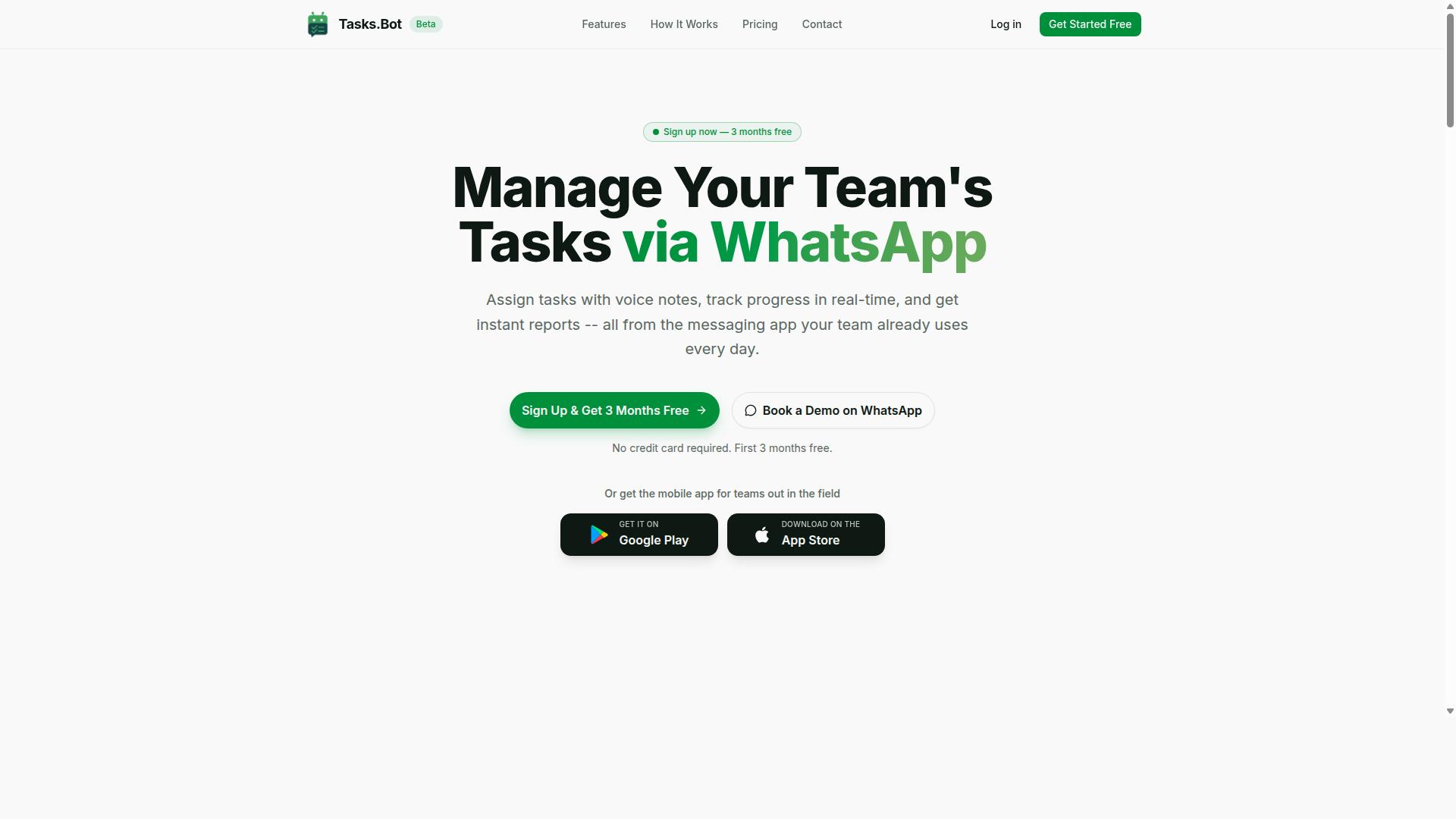
Tasks.Bot is a task management platform that lives inside WhatsApp, letting teams create, assign, and track tasks without leaving their chat app. It leverages AI to interpret natural language and voice notes, turning casual messages into structured, actionable tasks. This approach removes the friction of switching between a chat tool and a separate project management dashboard.
The core functionality covers task assignment, progress tracking, and report generation, all delivered within WhatsApp. A manager can assign work, team members can update status, and supervisors can review completed activities without installing heavy enterprise software. For teams that already run their daily communication through WhatsApp, this creates a seamless bridge between conversation and work execution.
Tasks.Bot also offers a mobile app designed for field teams. This is a key differentiator because it extends the platform beyond chat alone, giving remote workers a dedicated interface when they need it. The service operates as a cloud-based solution accessible globally, so there are no geographic restrictions on where teams can use it.
So who is this for? The primary audience is teams that already rely on WhatsApp for daily communication, particularly organizations with field staff. These are businesses that need task management, attendance tracking, and payroll-ready hours compiled from day-to-day operations. If your team lives in WhatsApp and you struggle to track what gets done in the field, Tasks.Bot is built for that exact scenario.
The service is currently in beta and offers a free trial period, which makes it low-risk for teams wanting to test the workflow before committing. For a 2026 buyer evaluating task management software, the appeal here is clear: it meets workers where they already are, rather than forcing a new communication habit.
Is Tasks.Bot Worth It? The 2026 Verdict
For teams that live in WhatsApp, Tasks.Bot delivers significant time savings and operational clarity, but its beta status and lack of integrations may give some buyers pause. The core question in any Tasks.Bot review comes down to whether the convenience of native WhatsApp collaboration outweighs the limitations of a still-maturing AI automation platform. For most small and medium teams, the answer is clearly yes.
The strongest argument in favor is the elimination of adoption friction. Because Tasks.Bot operates entirely within WhatsApp, team members don't need to install anything or create new accounts. This single factor removes the biggest barrier to success with task management software: getting the whole team to actually use it.
The AI layer adds genuine value beyond simple checklists. Tasks.Bot uses AI to understand natural language and voice notes for task creation, which means a field worker can dictate a task while on the move. For managers, the face-verified attendance and live GPS tracking for field staff provide a level of operational visibility that most competing productivity tools lack.
On the cost side, the value proposition is straightforward. The 3-month free trial with no credit card required lets you validate the ROI before spending anything. When you compare the subscription cost against the time saved on manual scheduling and follow-up messages, the math usually favors adoption for teams under 50 people.
The drawbacks are real but narrowing. The beta status means you should expect occasional rough edges, and the lack of Zapier integration or API access will frustrate teams with complex tech stacks. Also, pricing may add up for larger teams, making this a less obvious choice at scale.
So, is Tasks.Bot worth it in this 2026 buyer guide? Yes, for teams that prioritize WhatsApp-based collaboration and want workflow automation without retraining staff. It is not the right fit for enterprises needing deep integration capabilities, but for small business use and field operations, the combination of natural language processing, data security, and zero onboarding makes it an exceptional value.
Key Features That Make Tasks.Bot Stand Out
Tasks.Bot's features are designed to eliminate friction, from creating tasks with a voice note to tracking field staff in real time. The platform builds its entire value proposition around three core pillars: native WhatsApp integration, specialized field team tools, and AI-powered automation.
Traditional task management software often requires team members to learn a new interface, remember login credentials, and check yet another dashboard. Tasks.Bot takes the opposite approach by meeting users where they already communicate. This combination of familiar chat-based workflows, practical field tracking, and intelligent automation creates a unique value proposition for teams that need speed without sacrificing oversight.
Task Management Inside WhatsApp
Instead of forcing your team to adopt a new dashboard, Tasks.Bot turns your existing WhatsApp chats into a command center for task creation, assignment, and status updates. Team members simply send a message or a voice note to create a task, and the AI interprets the intent before automatically assigning it to the right person. There is no need to fill out forms or navigate through multiple screens.
Status updates work the same way. A quick chat reply can mark a task as complete, in progress, or blocked, and managers can set smart deadline reminders to keep work moving. Approvals and automations handle routine decision-making, while instant reports give leadership a clear view of what has been accomplished. The system also supports voice note creation, automatic task assignment, and tasks displayed on a map for visual context.
The user experience is deliberately simple. Since the platform operates entirely within WhatsApp, team members don't need to install anything or create new accounts. This dramatically reduces onboarding friction, because there is no training period for learning a new system. For field staff who need more advanced capabilities, Tasks.Bot also offers Android and iOS apps with push notifications, voice capture, and a home screen widget, but the WhatsApp interface remains the primary touchpoint for daily work.
Field Team Tools: Attendance, GPS, and Live Tracking
For managers with staff on the move, Tasks.Bot offers face-verified attendance and GPS-based live tracking to ensure accountability and accurate payroll. These tools directly address the pain points that come with managing remote or field-based employees who previously relied on manual check-ins or spreadsheets.
Face-verified attendance helps prevent buddy punching, where one employee clocks in for another who has not arrived. GPS location tagging attaches a physical location to each task, so managers can confirm that work was performed at the correct site. The live day tracker and tasks-on-a-map view give supervisors a real-time picture of where their team is and what they are working on at any given moment.
The practical benefits extend to payroll. Because attendance and hours are captured automatically, managers can generate payroll-ready hours without manually reconciling timesheets. The platform also handles shifts, leave, and hours management, reducing the administrative burden that typically falls on supervisors. For teams that have outgrown WhatsApp group chats and paper-based tracking, these tools offer a structured way to maintain visibility and control without sacrificing the convenience of mobile communication.
AI-Powered Voice Notes and Automations
Tasks.Bot's AI can parse voice notes and natural language commands, turning a quick 'Remind the plumber to call the client at 3 PM' into a scheduled, assigned task. This natural language processing capability is the engine that powers the platform's efficiency, allowing users to describe what they need in plain speech rather than navigating menus or writing out detailed instructions.
The AI uses natural language processing to understand user intent and create tasks from messages. This means a manager can dictate a task while walking between meetings, and the system will interpret the context, assign it appropriately, and set a smart deadline reminder. The no-code aspect is a major advantage, as users don't need to write complex rules or configure elaborate workflows. They simply type or speak naturally, and the AI handles the rest.
Automations extend beyond basic task creation. Recurring tasks can be scheduled to repeat on a set cadence, and the system can trigger automatic reassignment when a task becomes overdue. These features reduce manual data entry and help teams maintain momentum without constant managerial oversight. For a 2026 buyer evaluating a task management software purchase, the combination of voice note creation and smart deadline reminders represents a meaningful step forward in workflow automation. The AI assistant acts as an always-on coordinator, catching details that might otherwise slip through the cracks.
Pricing and Plans: What You Pay and What You Get
Tasks.Bot keeps pricing simple with a single 'Full Access' plan that includes all features, available in Indian Rupees and US Dollars. This one-plan approach stands out in a market where most task management software vendors layer on tiers, add-ons, and surprise fees. For a 2026 buyer, that simplicity removes a major headache from the evaluation process.
Instead of comparing feature matrices across three or four tiers, you evaluate one subscription cost. The decision narrows down to whether the tool fits your workflow, not whether you can afford the premium tier that actually has the features you need. This all-inclusive philosophy means every user gets the same capabilities, from task scheduling to natural language processing.
For teams, the per-member model scales predictably. You multiply the rate by your headcount and you know your total. There are no hidden fees for API access, no separate charges for chatbot integration, and no upgrade path to unlock basic functionality. The pricing structure itself supports a straightforward ROI analysis for small business use and enterprise deployment alike.
The currency flexibility matters for international teams. Whether you budget in rupees or dollars, you can see costs in your preferred currency from the start. This transparency aligns with the overall user experience, which prioritizes clarity over complexity. The single Full Access plan is a core reason why this AI automation platform earns a favorable spot in any 2026 buyer guide.
Full Access Plan: Monthly vs. Annual Costs
The Full Access plan costs 200 per member per month on a monthly basis, or 1,200 per member per year when billed annually, saving you 50%. Let's break down that math. Twelve months at the monthly rate would total 2,400 per member, so choosing annual billing cuts that figure in half.
The annual option saves 1,200 per member per year, which is a substantial discount for a productivity tool. For a team of ten, that is 12,000 in annual savings. For a growing business, those funds can go toward onboarding, training, or other workflow automation needs.
Here is a quick comparison of the two billing cycles:
| Billing Cycle | Cost Per Member | Annual Total Per Member |
|---|---|---|
| Monthly | 200 per month | 2,400 |
| Annual | 1,200 per year | 1,200 |
Every feature is included at either price point. There are no hidden fees, no premium modules, and no restrictions based on how you pay. The annual plan is clearly the better value for committed teams, while the monthly option suits those who want flexibility during a trial period.
Pricing is also available in US Dollars, but the rupee figures serve as the primary reference for cost calculations. When evaluating this task management software, consider the per-member cost against your team size. A five-person team pays 1,000 monthly or 6,000 annually, a modest investment for the time savings and no-code automation capabilities you gain. For most buyers, the annual plan delivers the strongest cost-benefit ratio among subscription options in this category.
Trust Signals: Beta Status, Security, and Refund Policy
Before committing, it's wise to consider Tasks.Bot's beta status, its approach to data security, and its refund policy. These three factors often determine whether a new AI automation platform feels like a safe investment or a risky gamble.
The service is currently in beta, which may raise a flag for cautious buyers. In this context, beta status signals that the product is actively improving, with new features and refinements landing on a regular basis. It also means occasional bugs may surface, though the core functionality of this task management software remains operational and dependable for daily workflow automation.
For most users, the beta phase is a net positive. You get early access to a productivity tool that is still being shaped by real feedback, and the development team has a clear incentive to polish the experience quickly. The trade-off is minor, especially when the essential scheduling and automation features work as expected.
Data security deserves a closer look. Tasks.Bot handles sensitive information like attendance records and location data, so privacy practices matter here. While the platform does not explicitly state GDPR compliance on its website, that absence is not proof of poor security. Still, any 2026 buyer guide should recommend reviewing the privacy policy directly before uploading confidential team data.
Ask yourself what data you plan to store. If your team tracks remote work locations or attendance logs, confirm that the platform's data handling aligns with your internal policies. This is a standard precaution for any AI automation platform, not a specific criticism of Tasks.Bot.
On the financial side, the website mentions a refund policy in the footer. That is a meaningful trust signal for a subscription-based product. Knowing you can recover your subscription cost if the software does not fit your needs reduces the risk of testing a new workflow automation tool.
- Beta status means active development and ongoing improvements
- Review privacy practices before storing sensitive location or attendance data
- A stated refund policy offers financial protection for early adopters
Global availability also works in your favor. Tasks.Bot serves users across multiple regions, which suggests the infrastructure is built to scale beyond a single market. For small business use or enterprise deployment, that reach indicates a serious commitment to reliability.
When you weigh the beta label against the refund policy and the platform's core capabilities, the risk profile looks reasonable. The natural language processing and task scheduling features are functional, and the no-code automation design keeps the user experience accessible. A refund policy provides the safety net that many productivity tools lack during their early stages.
The presence of a 'Book a Demo on WhatsApp' option also signals transparency. You can speak with someone before committing, which is more than many established competitors offer. That direct line of communication reduces uncertainty about how the AI assistant and chatbot integration actually work in practice.
In short, the trust signals here are balanced. Beta status is not a red flag, it is a sign of momentum. The refund policy protects your investment, and the global reach suggests a platform built for long-term growth. For buyers focused on time savings and cost-benefit analysis, Tasks.Bot presents a credible option worth evaluating in 2026.
Who Should Use Tasks.Bot?
Tasks.Bot is ideal for small to medium-sized teams that already rely on WhatsApp for daily communication, especially if they have field staff. Sales reps, service technicians, delivery personnel, and other mobile workers often struggle with traditional task management software that demands constant desktop access. This platform meets them where they already are, inside WhatsApp.
The tool is built for teams that need task management, attendance tracking, and payroll-ready hours without forcing workers to learn a new app. If your crew already lives in WhatsApp, the onboarding friction nearly disappears. That matters for small businesses that want results without a lengthy training period.
The brand's target audience is clear: teams that use WhatsApp for communication, particularly those with field staff. The site notes that hundreds of teams already use the service, which signals real-world traction in this niche. This is not a generic project management tool; it is a focused solution for a specific workflow.
Small businesses that want to avoid complex software will find this approach refreshing. Instead of juggling multiple platforms for scheduling, clocking in, and assigning work, everything lives in a familiar chat interface. The mobile-first approach means managers can coordinate from anywhere, and field workers never miss an update.
For organizations that prefer a mobile-first strategy, Tasks.Bot aligns perfectly with how modern teams actually operate. The platform is globally accessible, so distributed teams across different time zones can use the same system. That global reach makes it practical for companies with remote or traveling employees.
However, this is not the right fit for enterprises that need advanced integrations or large-scale project management. Large organizations with complex workflows, custom ERP systems, or heavy reporting requirements will likely outgrow this tool quickly. Tasks.Bot solves a specific problem well, but it does not pretend to replace heavyweight enterprise platforms.
Before you commit, run through this quick self-assessment checklist:
- Does your team already use WhatsApp as a primary communication channel?
- Do you have field staff who need clear task assignments while on the move?
- Are you tracking attendance or work hours manually and want a simpler way?
- Do you prefer a lightweight tool over a complex, feature-heavy platform?
- Is your team size in the small to medium range, not a large enterprise?
If you answered yes to most of these, Tasks.Bot likely fits your workflow. The platform targets a specific pain point: managing mobile teams through a tool they already use daily. For that audience, the value proposition is strong and the learning curve is minimal.
Final Verdict: Is Tasks.Bot Worth Your Team's Time?
If your team lives in WhatsApp and needs a simple, AI-powered way to manage tasks and field staff, Tasks.Bot is a compelling investment. The platform combines an intuitive user interface with practical AI automation that removes the friction from daily operations. For small teams, this balance of capability and simplicity is rare in the task management software market.
The core strengths are clear. Ease of use stands out immediately, since the familiar WhatsApp environment means no lengthy onboarding process. The AI assistant handles natural language processing for task scheduling, while recurring tasks and workflow automation keep repetitive work off your plate. Field team tools round out the offering, making it a genuine productivity tool rather than just another chat bot.
Cost-effectiveness matters for small business use, and Tasks.Bot delivers on that front. The pricing plans are positioned for teams that need real results without enterprise overhead. When you run a cost-benefit analysis against traditional project management software, the subscription cost becomes easy to justify. The time savings from AI automation alone often offset the investment in the first few weeks.
No review is complete without acknowledging limitations. Tasks.Bot is still in beta status, which means some rough edges may appear. The lack of extensive integration capabilities, including no Zapier integration or API access yet, could frustrate teams that rely on connected tool stacks. For most small teams, these gaps are manageable, but they deserve consideration before committing.
Here is a quick summary of where Tasks.Bot stands:
- Strengths: AI-powered task creation, WhatsApp-native experience, field team management, affordable entry point
- Limitations: Beta stage development, limited integration capabilities, no API access yet
- Best fit: Small teams, field service operations, businesses already using WhatsApp heavily
For the right audience, this is a worthwhile experiment. The free demo option removes most of the risk from the decision. You can see the platform in action before committing any budget, which is exactly how a 2026 buyer should approach new software. The user experience speaks for itself once you try it.
If you want to explore whether Tasks.Bot fits your workflow, the team is easy to reach. Book a demo via WhatsApp to see the platform working with your real tasks. You can call +91 97143 42522 or send an email to hello@tasks.bot to get started. The response is prompt, and the demo gives you a clear picture of what the AI assistant can do for your team.
In the crowded field of AI automation platforms, Tasks.Bot earns its place. It is not trying to be everything to everyone. It focuses on doing a few things well for the teams that need them most. For small businesses looking to streamline task management without a steep learning curve, this is a smart, practical choice worth your time.
Frequently Asked Questions
Does my team need to install anything to use Tasks.Bot?
No. Because Tasks.Bot operates entirely within WhatsApp, your team members can start assigning and tracking tasks right from their existing WhatsApp app-no new software, accounts, or logins required. The only optional addition is the mobile app, which is designed specifically for field teams who need map views and live day tracking.
How does Tasks.Bot handle task creation if my team prefers voice notes over typing?
Tasks.Bot uses AI to understand natural language and voice notes, so your team can simply send a voice message on WhatsApp to create a task. The system then handles automatic task assignment and smart deadline reminders, keeping the workflow hands-free and fast.
Is Tasks.Bot only for teams in India, or can we use it internationally?
Tasks.Bot is a global SaaS product-it works anywhere you have WhatsApp and an internet connection, with no country restrictions mentioned. Pricing is available in both Indian Rupees () and US Dollars ($), and the service is accessible worldwide.
What does the 'Full Access' plan actually include, and how much does it cost?
The 'Full Access' plan includes all features-voice note task creation, approvals, automations, instant reports, map views, and face-verified attendance-with no tiered limitations. It costs 200 per member per month, or you can save 50% with the annual plan at 1,200 per member per year.
Can Tasks.Bot help me track my field staff's attendance and working hours?
Yes, Tasks.Bot offers face-verified attendance and live day tracking, which is specifically built for teams with field staff. The system also produces payroll-ready hours, so you can move from raw attendance data to accurate payroll calculations without manual spreadsheets.
Is Tasks.Bot stable enough for my team to rely on it daily, given it's in beta?
Tasks.Bot is currently in beta, but the website states that hundreds of teams are already using the service, and it includes a refund policy in the footer for your protection. If you want to test it before committing, you can book a free demo directly on WhatsApp to see if the workflow fits your team's needs.